
How Long Does Full Synthetic Oil Last?
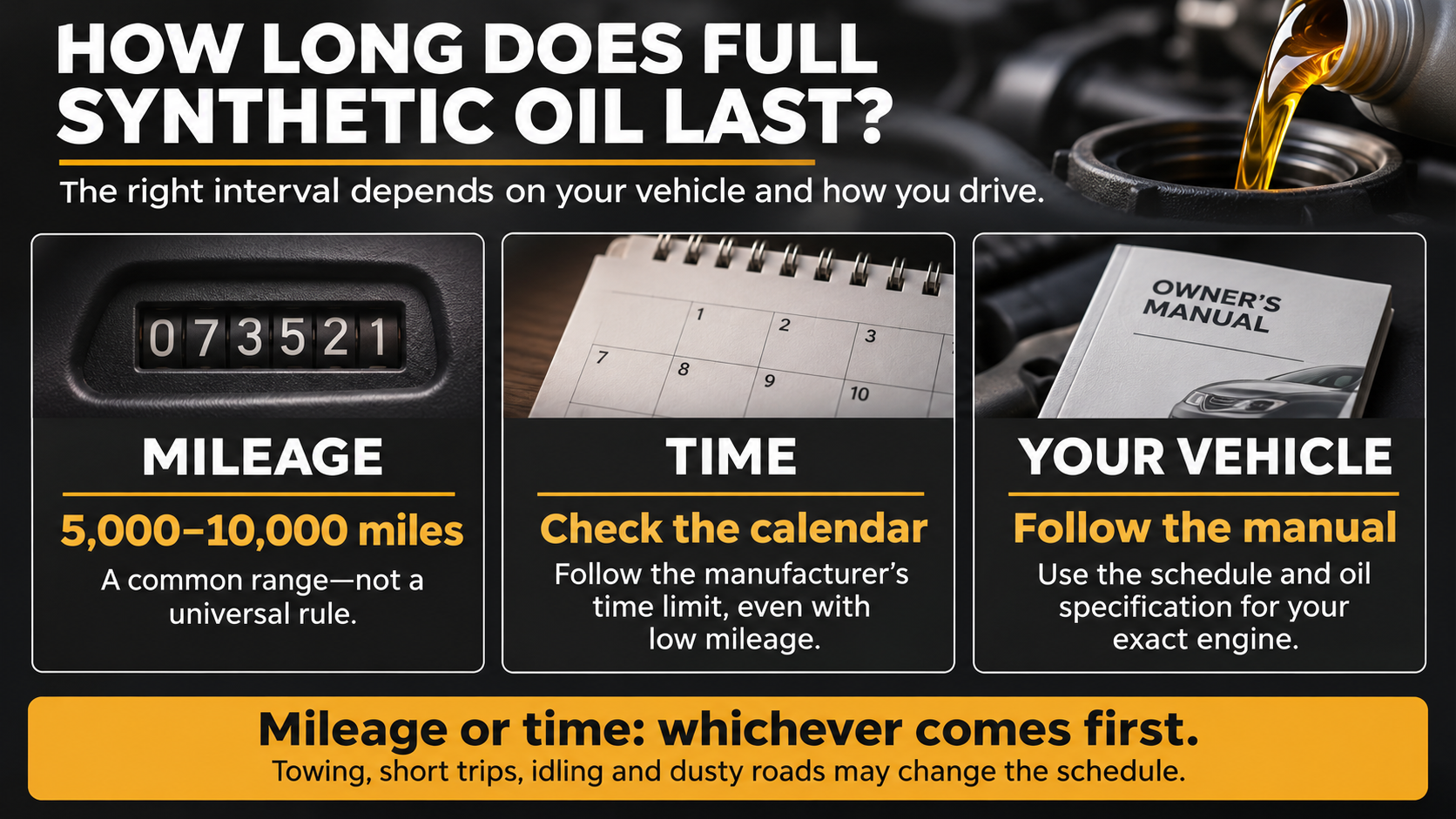
Full synthetic oil often supports oil-change intervals of 5,000 to 10,000 mile range in modern passenger vehicles, but there is no universal interval. Some vehicles require shorter service, while others permit longer intervals. Follow the manufacturer’s mileage, time, and operating condition requirements for your exact engine.
The phrase “full synthetic” can make oil maintenance sound simpler than it is.
Drivers see bottles advertising extended protection, hear that modern oil lasts longer, and wonder whether the next oil change can wait.
Sometimes it can. Sometimes the vehicle’s operating conditions make a shorter interval appropriate.
The important distinction is between what an oil product is capable of under specified conditions and what your engine requires in actual use.
For drivers in Mabank and Canton, repeated short trips, towing, dusty roads, and summer driving can all influence the maintenance discussion.
Understanding how synthetic oil ages helps you choose a service interval that protects the engine without relying on guesswork.
Why Full Synthetic Oil Can Last Longer
Motor oil must resist heat, oxidation, mechanical stress, and contamination while maintaining useful lubrication.
Full synthetic formulations generally offer stronger resistance to degradation than comparable conventional oils.
That can support longer service intervals in engines designed for them.
However, synthetic oil is not immune to fuel dilution, moisture, contamination, or additive depletion. It also cannot protect an engine properly if the oil level becomes too low.
Think of synthetic oil as providing performance capabilities, not unlimited service life.
The vehicle manufacturer considers the engine’s design, capacity, operating characteristics, and required oil standards when establishing maintenance requirements.
Those requirements remain the starting point.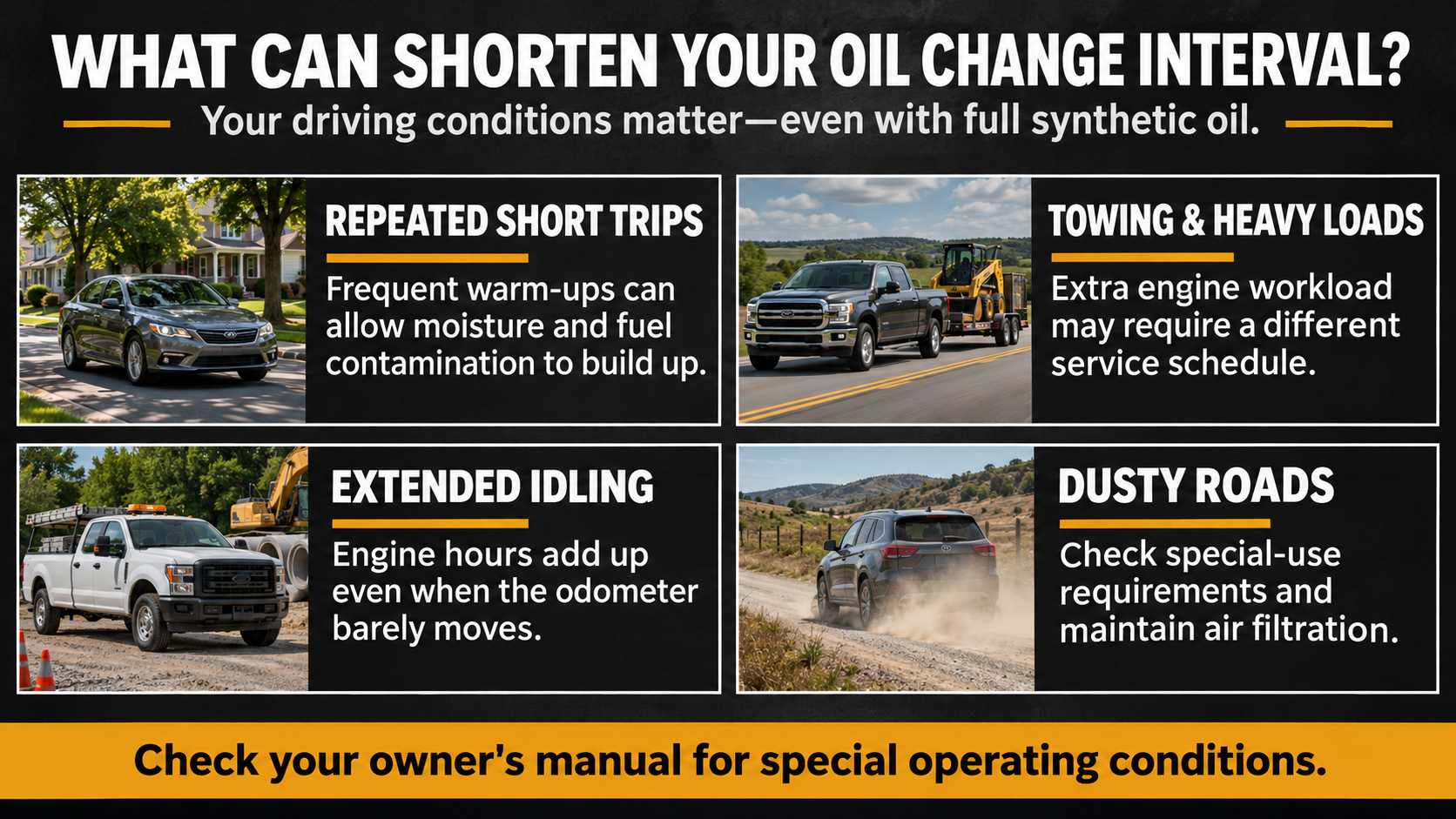
Mileage and Time Both Matter
An oil change interval usually includes more than a mileage figure.
A vehicle may reach its calendar limit before accumulating the listed miles. This is especially relevant for vehicles driven infrequently or mainly on short trips.
For example, Toyota publishes a 10,000-mile or 12-month interval for certain vehicles requiring 0W-20 synthetic oil, while also directing owners to vehicle-specific maintenance requirements and special operating conditions. That example should not be applied to every Toyota or every synthetic-oil vehicle. Source: Toyota
The principle is broader: When the schedule says “whichever comes first,” both limits matter.
Low annual mileage does not automatically justify leaving oil in the engine for several years.
Review your last service date as carefully as the odometer reading.
How to Find the Correct Interval
Start with the maintenance section of the owner’s manual.
Confirm that you are reading the schedule for the correct engine, model year, and market.
Then look for separate instructions covering special operating conditions. These may include towing, extensive idling, repeated short trips, dusty operation, or other uses.
If the vehicle uses an oil life monitor, read the manufacturer’s instructions on how to respond to it and whether a maximum calendar interval still applies.
Finally, verify that the oil used at the last service met the required specifications.
A long interval approved for one oil specification should not be assumed appropriate when an unsuitable product was installed.
If the records are unclear, Burnett Tire’s oil change service can provide a practical opportunity to review the requirements and establish a documented starting point.
Why Your Driving Pattern Changes the Answer
Short trips
Repeated short trips can be demanding because the engine may spend much of its operating time warming up.
Moisture and fuel contamination may not be managed as effectively as during sustained operation.
A vehicle driven only a few miles at a time can therefore need attention even when its annual mileage is low.
Towing and heavy loads
Pulling a trailer increases engine workload.
The maintenance schedule may change when towing is frequent or sustained, especially in hot weather or on demanding routes.
Synthetic oil does not cancel those requirements.
Idling
A work vehicle may spend substantial time running while stationary.
That adds operating hours without much mileage. The odometer alone can understate how much work the oil has done.
Dusty conditions
Driving on dusty roads makes the condition of the intake system and air filtration important.
Oil and air filter maintenance should be considered together, while recognizing that replacing one does not substitute for servicing the other.
Mechanical problems
Fuel-system faults, coolant leaks, overheating, and other problems can affect oil condition.
An ordinary maintenance interval does not guarantee anything when the engine has an active fault.
Does Highway Driving Help Oil Last Longer?
Longer, steady trips can be less demanding in some respects than repeated cold starts and short journeys.
The engine has time to reach stable operating conditions, and mileage accumulates without an equivalent increase in the number of starts.
However, “highway driving” is not automatically gentle.
Towing at highway speed, climbing long grades, driving at high load, or operating in extreme conditions can increase demands.
Use the manufacturer’s definitions rather than assuming all highway miles qualify for the longest possible interval.
The route, load, and operating conditions matter.
Can Full Synthetic Oil Last 15,000 or 20,000 Miles?
Some oil products advertise extended protection at those mileages under specified conditions.
That does not establish an appropriate interval for every vehicle.
The engine manufacturer’s requirements, oil filter capability, operating conditions, and product terms still matter.
A vehicle that requires a shorter interval should not be driven farther simply because the oil bottle lists a larger number.
Extended-drain strategies can involve a more deliberate program, including appropriate filtration, maintenance controls, and, sometimes, used oil analysis.
For ordinary passenger vehicle maintenance, the most straightforward approach is to follow the vehicle’s approved schedule.
A marketing claim should not become a substitute for the owner’s manual.
What Does an Oil Life Percentage Mean?
An oil life display generally estimates when service is needed.
It is not the same as an oil level gauge.
If the display shows 30% oil life remaining, the engine could still be low on oil because of consumption or leakage.
Different vehicles use different methods to estimate oil life. Some systems respond to operating conditions; others are more closely tied to mileage and time.
Follow your vehicle’s instructions.
Also, confirm that the monitor was reset after the last completed service. A reset performed without an oil change can make the reading unreliable, while a missed reset can make fresh oil appear overdue.
Keep the service receipt as a separate record.
Why Oil Color Cannot Tell You the Remaining Mileage
Many drivers judge oil by whether it looks dark.
Color can provide context, but it is not a reliable measurement of remaining oil life.
Oil can darken while still performing normally. Conversely, oil may appear relatively clean while being affected by fuel dilution or other changes that are difficult to judge visually.
Texture, smell, and appearance also cannot replace a proper diagnosis when a problem is suspected.
For routine maintenance, use the service schedule and operating history.
For unusual symptoms, investigate the cause.
Do not wait for oil to become visibly thick or sludged before deciding it needs attention.
Oil Level Can Matter Before the Next Change Is Due
Even a high-quality synthetic oil cannot protect components if there is not enough of it in the system.
Check the level according to the vehicle’s instructions.
If you need to add oil, use the specified product and avoid overfilling.
Record repeated additions. A pattern of adding oil between changes may indicate consumption, an external leak, or another issue requiring inspection.
Do not assume a longer service interval means the vehicle can go longer without checks.
In fact, longer intervals make it more important to separate the oil change schedule from the oil level inspection routine.
Does Topping Off Extend the Oil Change Interval?
Adding oil restores the level, but it does not fully replace the used oil or reset its operating history.
The oil already in the engine remains exposed to the same heat and contamination. The filter also remains in service.
A top-off should therefore not be treated as a new oil change.
If a vehicle consumes enough oil that you are regularly adding substantial amounts, the priority is understanding why.
Continuously adding oil without investigating the loss can conceal a developing problem and complicate maintenance records.
The Filter Has Its Own Job
Synthetic oil still needs appropriate filtration.
The filter collects contaminants, and its suitability depends on more than whether it physically fits.
The correct filter must match the application and intended service.
A long-life oil should not be paired with an unsuitable filter and then assumed safe for an extended interval.
During routine service, the oil and filter should be handled in accordance with the manufacturer’s requirements.
The filter’s condition cannot usually be determined by looking at its exterior.
If you are comparing oil change quotes, confirm that the correct filter and full oil quantity are included.
Does High Mileage Mean Shorter Oil Changes?
Not automatically.
An older engine that is well-maintained and operating normally may continue following its established schedule.
An engine with oil consumption, leaks, deposit problems, or a demanding duty cycle may require a different approach.
The odometer is one factor, not a diagnosis.
Likewise, switching to high-mileage synthetic oil does not automatically justify extending the interval.
The formulation must meet the engine’s requirements, and the service schedule should reflect the vehicle’s condition.
A Practical Example
Imagine your vehicle has 2,000 miles remaining before its next required service, but you are planning a 1,700-mile trip.
The trip also includes several days of local driving and towing a small trailer.
Looking only at the advertised route mileage may lead you to believe you can wait. Considering the full travel plan and applicable towing schedule may lead to a different decision.
Now consider a vehicle whose oil was recently changed to the correct level, with no symptoms.
A weekend trip does not automatically require another oil change.
The useful approach is to compare actual service history with actual planned use.
Can Used Oil Analysis Help?
A laboratory can test a sample of used oil for selected properties and contaminants.
Depending on the test, results may help evaluate changes in viscosity, fuel dilution, wear metals, coolant contamination, and other conditions.
This can be useful for fleets, unusual duty cycles, or a specific diagnostic question.
However, a single sample has limitations. Results are often more informative when interpreted as part of a trend and alongside maintenance records.
Used-oil analysis should not be treated as permission to ignore warranty requirements or operate through warning symptoms.
For most drivers, a correct maintenance schedule is simpler than creating a custom extended-drain program.
Fall Car Care: Review Oil Service Before Travel
Fall is a convenient time to review the service date, oil level, and expected travel mileage after summer driving.
For Mabank and Canton drivers, the checklist should also include tires, brakes, lights, wipers, and the cooling system.
If tire pressure has been neglected, Burnett’s tire services can help address inspection, rotation, and related needs.
The Car Concepts fall car care guide provides a broader checklist for preparing the vehicle.
Seasonal maintenance works best when it identifies what the car actually needs rather than replacing parts simply because the calendar has changed.
Frequently Asked Questions
Can I wait a year if I drive very little?
Only if the manufacturer permits that interval for your vehicle and operating conditions. Some vehicles or duty cycles require shorter time limits.
Is 10,000 miles always safe with synthetic oil?
No. It is appropriate only when the vehicle’s requirements and operating conditions support it.
Does synthetic oil expire inside the engine?
There is no single expiration date for every application. Follow the vehicle’s time limit and consider contamination, use, and engine condition.
Can I keep driving when oil life reaches zero?
Follow the service reminder in the owner’s manual and promptly arrange service. Do not use zero as the beginning of an additional unofficial interval.
Will changing brands shorten the next interval?
Not necessarily. What matters is whether the replacement oil meets the required specifications and whether the manufacturer’s schedule is followed.
Schedule an Oil Change in Mabank or Canton
The best answer to how long synthetic oil lasts is specific to your engine and driving.
Visit Burnett Family Tire & Auto Service to review your maintenance needs or learn more about oil change service.
Bring the date and mileage of your last service, especially if you are unsure which oil was used or whether upcoming travel will put you past the next interval.