
What Is a Tire Ply Rating? Understanding Load Range, Load Index, PSI, and Tire Strength
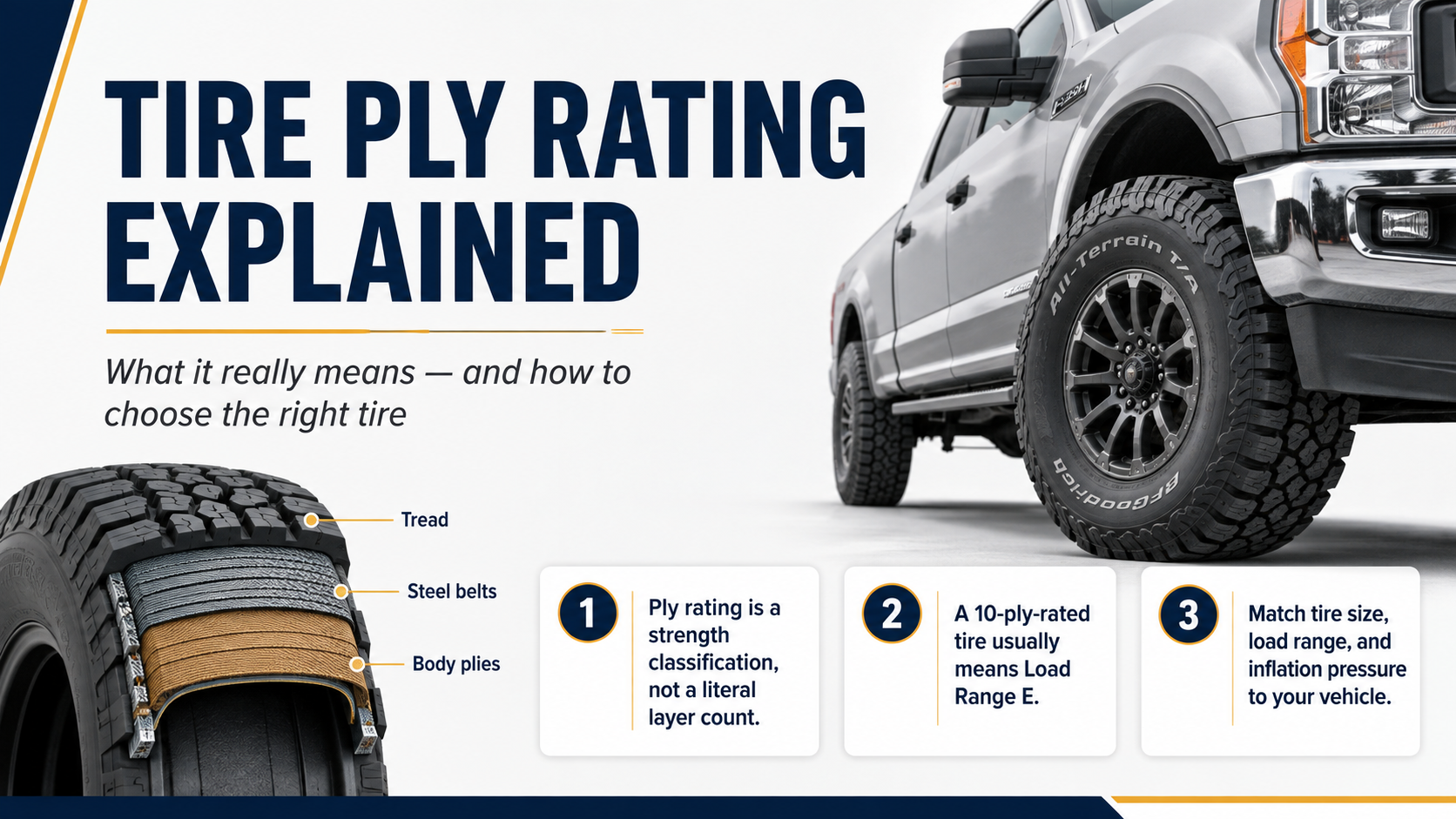
The phrase tire ply rating sounds straightforward. A 10-ply tire must contain 10 layers, an 8-ply tire must contain eight layers, and a 6-ply tire must be lighter and weaker than both.
That was closer to the truth many decades ago. It is usually not how modern tires are built.
Today, a tire’s ply rating is primarily a strength classification associated with its load-carrying and inflation capabilities. A modern tire advertised as “10-ply” may have only two actual body plies in its sidewalls, along with separate steel belts and reinforcement layers beneath the tread. Modern synthetic cords and steel materials can produce the strength that once required many more layers of cotton fabric.
That distinction matters when buying tires for a pickup, work truck, trailer, SUV, RV, or commercial vehicle. Choosing the highest ply rating available does not automatically give you the safest tire, the largest legal payload, or the best ride. The correct tire must match the vehicle’s weight, axle ratings, wheel capacity, operating pressure, towing demands, and manufacturer specifications.
Burnett Family Tire & Auto Service helps drivers compare pickup and light-truck tires, passenger tires, trailer tires, and commercial truck tires based on how the vehicle is actually used. With locations in Canton and Mabank, TX, Burnett provides tire selection, professional installation, balancing, rotation, alignment, and ongoing tire maintenance for drivers throughout East Texas.
What Does Tire Ply Rating Mean?
A tire ply rating is a historical way of describing a tire’s relative strength and load-carrying capability.
Early pneumatic tires used multiple layers of cotton cord fabric to reinforce the casing. A tire with six layers was commonly described as a s6-ply tire. Adding plies generally increased the tire’s ability to operate at higher pressures and carry more weight.
As tire technology improved, manufacturers began using stronger materials such as polyester, rayon, nylon, aramid, and steel. These materials could provide equal or greater strength with fewer physical layers.
The old ply terminology remained useful as a performance classification, even though it no longer described the literal construction of most tires.
The National Highway Traffic Safety Administration (NHTSA) has described ply rating as an older system that served the function now largely performed by load-range designations. Under the historical system, higher ply ratings represented greater load-carrying capability, but the rating did not necessarily identify the tire’s actual number of structural plies.
A 10-ply-rated tire should therefore be understood as:
A tire engineered to meet the load and inflation requirements historically associated with a 10-ply tire.
It does not necessarily contain 10 separate fabric layers.
Does a 10-Ply Tire Actually Have 10 Plies?
Usually not.
A modern Load Range E light-truck tire may be marketed as a 10-ply-rated tire, yet the sidewall may show construction similar to:
- Sidewall: Two polyester plies
- Tread: Two polyester plies
- Two steel belts
- One nylon reinforcement layer
That tire contains several structural and reinforcement layers, but it does not have 10 identical body plies.
USTMA’s light-truck sidewall example uses an LT245/75R16 Load Range E tire whose markings indicate two polyester sidewall plies and a tread package consisting of two polyester, two steel, and one nylon layers. The same tire carries the historical Load Range E classification commonly associated with a 10-ply rating.
This is why the terms 10-ply, 10-ply rated, and Load Range E are often used interchangeably in tire marketing, even though only the second and third accurately describe the modern tire’s classification.
What Is an Actual Tire Ply?
A ply is a layer of reinforcing cord embedded in rubber.
The cords provide structural strength and help the tire maintain its shape under pressure, vehicle weight, acceleration, braking, cornering, and road impact.
Modern radial tires generally contain several different structural elements.
Body or Carcass Plies
The body ply forms the tire’s basic structural casing. In a radial tire, the cords run from bead to bead, nearly perpendicular to the direction of travel.
The carcass must flex as the tire enters and leaves the contact patch. It also helps contain inflation pressure and supports the load transmitted between the wheel and road.
Steel Belts
Steel belts are positioned beneath the tread and run at opposing angles. They stabilize the tread area, increase strength, help control the contact patch, and improve resistance to deformation.
Steel belts are not the same as sidewall body plies, even though both contribute to the tire’s overall construction.
Cap Plies or Reinforcement Layers
Some tires use nylon, aramid, or other reinforcement above the steel belts. These layers can help control tread growth, heat, and deformation at higher speeds.
Inner Liner
A tubeless tire contains an air-resistant inner liner that helps retain inflation pressure. The liner is not generally counted as a structural ply.
Beads
The bead assemblies contain high-strength wire that holds the tire securely against the wheel. Beads must tolerate substantial forces from inflation, vehicle weight, mounting, braking, and cornering.
Sidewall Rubber
The outer sidewall rubber protects the structural cords from weather, flexing, abrasion, and minor impacts. A thicker-looking sidewall does not necessarily tell you the tire’s load capacity or number of internal plies.
Nearly all current passenger and light-truck tires use radial construction. USTMA explains that radial tires use body cords that run almost perpendicular to the beads, with separate steel or reinforced-belt plies beneath the tread.
Ply Rating vs. Load Range
Load range is the modern letter-based classification most closely associated with traditional ply rating.
Common historical equivalents include:
| Historical ply rating | Common load range |
| 2-ply rated | A |
| 4-ply rated | B |
| 6-ply rated | C |
| 8-ply rated | D |
| 10-ply rated | E |
| 12-ply rated | F |
| 14-ply rated | G |
| 16-ply rated | H |
| 18-ply rated | J |
| 20-ply rated | L |
| 22-ply rated | M |
The letters I and K are omitted to reduce the risk of confusion with numbers or other tire markings. Bridgestone’s commercial tire data book shows the traditional relationship between ply ratings and load-range letters, including 10-ply/Load Range E, 12-ply/Load Range F, 14-ply/Load Range G, and 16-ply/Load Range H.
For most consumer pickup applications, the most frequently encountered categories are:
- Load Range C
- Load Range D
- Load Range E
- Increasingly, Load Range F on certain heavy-duty and larger-diameter truck tires
Commercial trucks, buses, RVs, trailers, and specialty equipment may use higher load ranges.
The load range identifies the tire’s load and inflation limits within that tire size and service category. It should not be interpreted as a universal weight rating independent of size.
Ply Rating vs. Load Index
Ply rating and load index are related, but they are not the same measurement.
Ply Rating or Load Range
Load range identifies a general load-and-inflation class.
For example:
- Load Range C commonly corresponds to a 6-ply rating.
- Load Range D commonly corresponds to a 8-ply rating.
- Load Range E commonly corresponds to a 10-ply rating.
Load Index
The load index is a numerical code tied to the maximum weight the tire can carry under specified conditions.
A passenger tire may show a service description such as:
99H
The number 99 is the load index. The letter H is the speed rating.
A light-truck tire may show two load indices:
LT245/75R16 120/116Q
In that example:
- 120 is the load index for a single tire.
- 116 is the load index when the tire is used in a dual-wheel assembly.
- Q is the speed symbol.
- The tire may separately show Load Range E.
Michelin explains that the load-rating number identifies the maximum weight one tire can carry when properly inflated, while the speed symbol identifies the tire’s rated speed capability under specified conditions. Replacement tires should meet the vehicle manufacturer’s required load and speed specifications.
Why Two Tires With the Same Ply Rating Can Carry Different Loads
A common mistake is assuming every Load Range E tire carries the same amount of weight.
It does not.
The tire’s load capacity depends on several factors, including:
- Tire size
- Tire type
- Load index
- Inflation pressure
- Single or dual application
- Rim width and capacity
- Applicable tire standards
- Vehicle application
A Load Range E tire in one size may carry substantially more or less weight than a Load Range E tire in another size.
Consider two imaginary tires:
- LT225/75R16 Load Range E
- LT285/75R18 Load Range E
Both are 10-ply-rated Load Range E tires, but their dimensions, air volumes, load indexes, and maximum load capacities may differ significantly.
This is why selecting a tire by saying “I need a 10-ply” is incomplete. You also need the correct size, load index, inflation capability, wheel compatibility, and vehicle fitment.
The U.S. Tire Manufacturers Association (USTMA) recommends replacement tires with the same size, load index, and speed-rating designation recommended by the vehicle or tire manufacturer. A replacement should never have less load-carrying capacity than the original specification.
Understanding a Light-Truck Tire Sidewall
A common light-truck size may look like this:
LT245/75R16 120/116Q Load Range E
Each part provides different information.
LT
LT means the tire is designed for light-truck use under the LT-metric system.
An LT tire is engineered differently from a normal P-metric or passenger-metric tire. LT tires are commonly designed for higher operating pressures, heavier loads, towing, commercial service, and more demanding use.
245
The tire is approximately 245 millimeters wide at its nominal section width.
75
The sidewall height is 75% of the tire’s section width.
R
The tire uses radial construction.
16
The tire is designed for a 16-inch wheel.
120/116
These are the load indexes for single- and dual-application scenarios.
Q
This is the speed symbol.
Load Range E
This identifies the load and inflation class commonly described as a 10-ply rating.
A tire’s sidewall will also state its maximum load and the cold inflation pressure associated with that maximum. In USTMA’s example, the LT245/75R16 Load Range E tire shows a maximum single load of 3,042 pounds and a maximum dual load of 2,778 pounds at 80 psi cold. Those figures apply to that specific example and should not be treated as universal values for every Load Range E tire capacity.
Do You Need 10-Ply Tires for Towing?
Not always.
You need tires with sufficient capacity for the actual load on each axle while meeting the vehicle manufacturer’s required size, type, pressure, and load rating.
Towing affects the vehicle’s tires because trailer tongue weight is transferred to the tow vehicle. Cargo, passengers, accessories, tools, fuel, and the hitch also contribute to axle loads.
A half-ton truck pulling a moderate utility trailer may not require Load Range E tires if its original tires provide sufficient capacity. A 3/4-ton diesel towing a large fifth-wheel trailer may require them as original equipment.
The most accurate approach is to weigh the loaded vehicle and trailer on a certified scale. Obtain:
- Steer-axle weight
- Drive-axle weight
- Trailer-axle weight
- Total combined weight
Then compare those measurements with:
- Front GAWR
- Rear GAWR
- GVWR
- Trailer GVWR
- Tire load capacities
- Wheel ratings
- Hitch ratings
Never estimate tire requirements based solely on trailer dry weight or an advertised maximum towing figure.
Choosing the Right Ply Rating for an Off-Road Tire
Off-road use introduces demands beyond normal load capacity.
A tire may encounter:
- Rocks
- Roots
- Sharp gravel
- Mud
- Sand
- Sidewall flex
- Low-pressure operation
- Heavy impacts
- Uneven terrain
A higher load range may provide a more robust casing, but it may also be harder to flex at reduced off-road pressure. A very stiff tire on a light vehicle may not conform to terrain as effectively as a more appropriate lower-load-range tire.
Off-road tire selection should consider:
- Vehicle weight
- Wheel width
- Expected terrain
- Air-down pressure
- Sidewall construction
- Bead retention
- Tread pattern
- Cut and chip resistance
- Highway mileage
- Towing requirements
The best tire for a heavy diesel truck is not automatically the best tire for a lighter Jeep or midsize pickup.
Tire Ply Rating for Commercial Vehicles
Commercial tires operate under more demanding load, mileage, pressure, and heat conditions than typical passenger tires.
Commercial tire selection may require consideration of:
- Steer, drive, or trailer position
- Single or dual configuration
- Axle scale weights
- Load-and-inflation tables
- Duty cycle
- Highway or mixed-service operation
- Speed restrictions
- Retreadability
- Scrub resistance
- Fuel efficiency
- Casing durability
Commercial load ranges frequently extend beyond the C-E range common on pickups.
Inflation should be based on actual loads and the manufacturer’s load-and-inflation data. Bridgestone’s commercial tables show that capacity varies with tire size, load range, single or dual use, and cold inflation pressure.
Burnett Family Tire & Auto Service offers commercial truck tires in Canton and Mabank for local businesses, fleet vehicles, work trucks, trailers, and commercial applications.
Find the Right Tire Ply Rating in Canton or Mabank, TX
Ply rating remains useful, but it is only one part of choosing the correct tire.
A 10-ply-rated Load Range E tire may be the right option for a heavy-duty pickup, work vehicle, tow rig, or commercial truck. It may be unnecessary for an unloaded SUV or half-ton truck that was engineered around passenger-rated tires.
The correct decision requires looking at the complete tire specification:
- Tire type
- Size
- Load range
- Load index
- Single or dual rating
- Maximum load
- Required inflation
- Wheel capacity
- Vehicle axle ratings
- Actual towing and hauling demands
Burnett Family Tire & Auto Service can help you shop for tires by vehicle or size, compare pickup and light-truck tire options, and select the right load capacity without sacrificing comfort or efficiency beyond what’s necessary.
Burnett also provides professional tire installation, wheel balancing, tire rotation, wheel alignment, and puncture inspection at its Canton and Mabank locations.
Visit the Burnett Family Tire & Auto Service location page or book a tire service appointment for help choosing tires that match your vehicle, workload, and East Texas driving conditions.